
Table of Contents
- What Is the NDHCE?
- Who Administers the NDHCE?
- Who Is Eligible to Write the NDHCE?
- How to Register for the NDHCE
- NDHCE Exam Format: Questions, Timing, and Structure
- What Subjects Are on the NDHCE?
- Canadian-Specific NDHCE Content Students Should Not Ignore
- NDHCE Sample Questions: What to Expect
- How Much Does the NDHCE Cost?
- NDHCE Pass Rates and FDHRC Results
- How to Check Your FDHRC Results
- What Happens If You Do Not Pass the NDHCE?
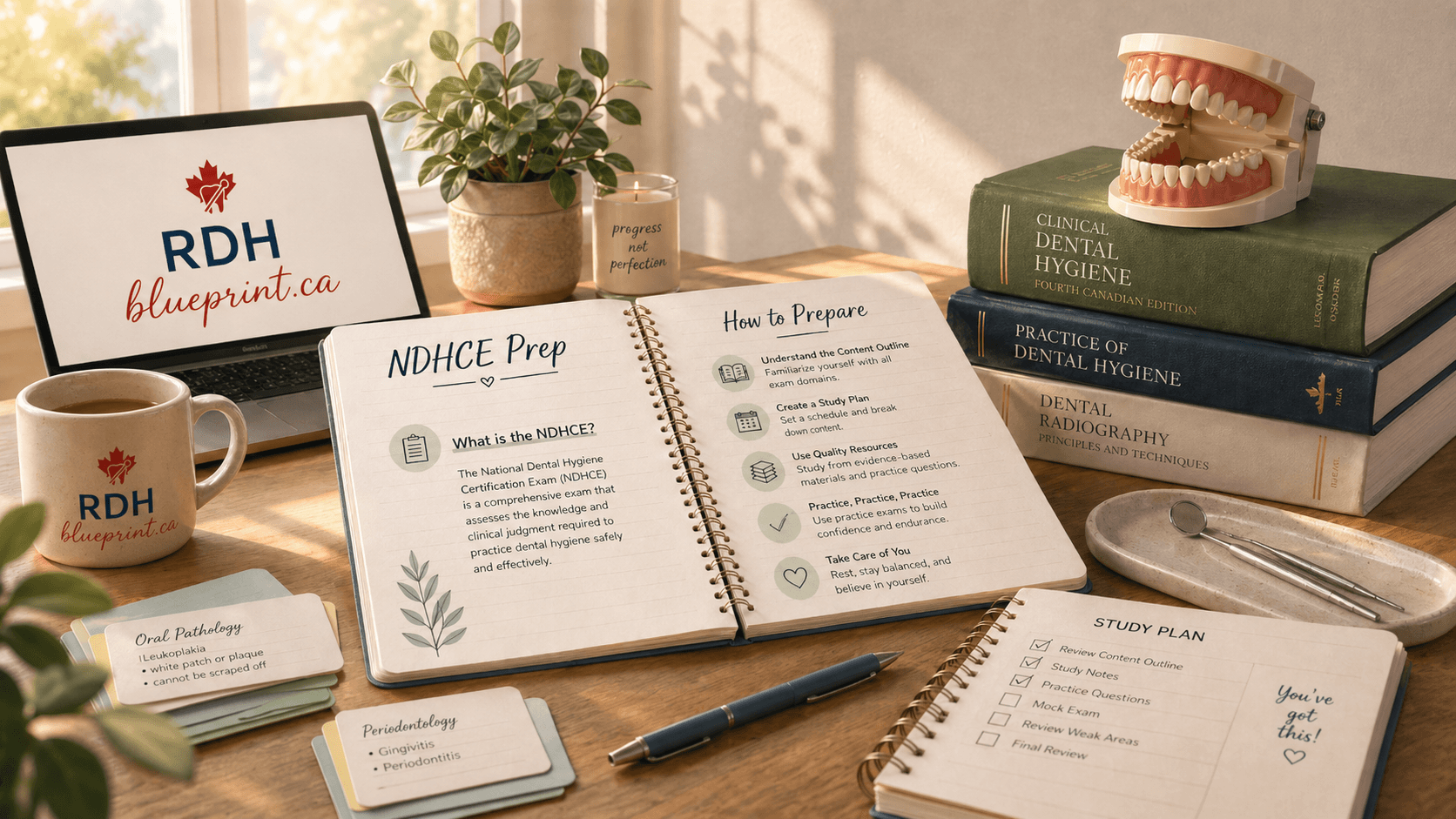
- How to Prepare for the NDHCE
- Why Canada-Specific NDHCE Prep Materials Matter
- Final Thoughts
- FAQs
What Is the NDHCE?
The dental hygiene board exam in Canada is commonly known as the National Dental Hygiene Certification Examination, or NDHCE. The NDHCE prep is an important step for dental hygiene graduates who want to become registered dental hygienists in Canada. The exam is designed to assess whether candidates have the knowledge, judgment, and skills expected of an entry-level dental hygienist.
In simple terms, the NDHCE helps determine whether a candidate is ready to practise safely, ethically, and competently as a dental hygienist in Canada.
The NDHCE is not just a memory test. It is designed to assess how well candidates can apply dental hygiene knowledge in realistic situations. This means the exam may test your ability to interpret client information, apply clinical judgment, choose the most appropriate intervention, and understand professional responsibilities. Time makes choosing the correct NDHCE prep all the more important.
The FDHRC describes the NDHCE as an exam that measures the knowledge, judgment, and skills of new Canadian dental hygiene graduates and internationally trained dental hygiene professionals against national standards.
For students, this means studying for the NDHCE should involve more than memorizing notes. You need to practise applying information the way you would in real clinical decision-making.
Who Administers the NDHCE?
The NDHCE is administered by the Federation of Dental Hygiene Regulators of Canada, also known as the FDHRC.
The FDHRC is responsible for developing, administering, and overseeing the national dental hygiene certification exam. It also maintains a registry of successful candidates.
When preparing for the NDHCE, candidates should always use the FDHRC website as the official source for exam dates, eligibility requirements, policies, fees, and results.
Who Is Eligible to Write the NDHCE?
Eligibility depends on your educational background.
In general, candidates may be eligible if they are graduating from or have graduated from an accredited dental hygiene program. Students in accredited programs may be able to apply before graduation if their program confirms they are close to completion by the required deadline.
Canadian Dental Hygiene Students and Graduates
Most Canadian dental hygiene students write the NDHCE after completing, or near completing, an accredited dental hygiene program.
If you are currently enrolled in a Canadian dental hygiene program, your school may provide information about when you are eligible to apply and what documentation is required.
Internationally Trained Dental Hygienists
Internationally trained dental hygienists may need to complete additional steps before they are eligible to write the NDHCE.
FDHRC states that internationally educated dental hygiene professionals who want to practise in Canada must first apply for a formal equivalency assessment of their education and professional credentials. They should also contact the regulatory college in the province where they plan to work to confirm all licensure requirements.
Graduates of Non-Accredited Programs
If you graduated from a dental hygiene program that is not accredited by CDAC or ADA-CODA, you are not automatically eligible to write the NDHCE. FDHRC explains that graduates of non-accredited programs must first apply for an equivalency evaluation.
Because eligibility rules can change, always confirm your personal situation directly with FDHRC and your provincial dental hygiene regulator.
How to Register for the NDHCE
Registration for the NDHCE is completed through the FDHRC when the application period opens for a specific exam sitting.
Before registering, candidates should carefully review:
- application deadlines
- required documents
- legal name requirements
- identification requirements
- exam fee information
- testing centre information
- accommodation requests, if needed
Candidates should make sure the name used on the application matches their government-issued identification. Small mistakes can create unnecessary stress close to exam day.
NDHCE Exam Format: Questions, Timing, and Structure
The NDHCE is a computer-based exam.
According to the 2026 FDHRC NDHCE information, the exam includes 200 questions total. Of those, 170 questions are operational, meaning they count toward the score, and 30 questions are experimental, meaning they are not scored. Candidates do not know which questions are experimental.
The exam is divided into two sections:
| NDHCE Feature | Details |
|---|---|
| Total questions | 200 |
| Scored questions | 170 |
| Experimental questions | 30 |
| Sections | 2 sections of 100 questions |
| Time | 2 hours per section |
| Break | 15-minute health break |
| Question style | Independent and case-based questions |
Once the first section is submitted, candidates cannot return to it. This means time management is important during the exam.
What Subjects Are on the NDHCE?
The NDHCE covers many areas of dental hygiene practice. It is not limited to one subject, and it does not only test isolated facts.
The 2026 NDHCE overview lists the following domains of expertise:
- Professionalism
- Evidence-informed practice
- Communication
- Collaboration
- Practice management
- Prevention, education, and health promotion
- Clinical therapy
Clinical therapy makes up the largest portion of scored exam items, followed by prevention, education, and health promotion. The FDHRC also states that the exam includes knowledge, application, and critical thinking questions, with application making up the largest portion.
For students, this means you should prepare across all major dental hygiene subjects, including:
- periodontics
- periodontal staging and grading
- oral pathology
- radiography or radiology
- pharmacology
- local anesthesia
- medical emergencies
- infection prevention and control
- ethics and jurisprudence
- research and statistics
- nutrition
- smoking cessation
- immunity
- client education
- dental hygiene process of care
The NDHCE often requires you to connect these subjects together. For example, a question may involve a medically compromised client, a periodontal finding, a pharmacology consideration, and a client education decision all in one scenario.
Canadian-Specific NDHCE Content Students Should Not Ignore
Many dental hygiene concepts overlap between Canada and the United States, but the NDHCE is a Canadian exam.
This matters because some study resources are designed for American board exams, not the Canadian dental hygiene board exam. While those resources may still teach useful concepts, they may not always reflect Canadian terminology, Canadian expectations, or the way the NDHCE is structured.
Important Canadian-specific areas include:
FDI Tooth Numbering
Canadian dental hygiene students should be comfortable with FDI tooth numbering. If you rely heavily on U.S.-based resources, you may see the Universal Numbering System more often, which can create confusion when preparing for a Canadian exam.
Canadian IPAC Expectations
Infection prevention and control is an important part of safe dental hygiene practice. Candidates should understand Canadian infection prevention and control expectations, terminology, and decision-making.
Canadian Pharmacology and Scope of Practice
Pharmacology questions may involve medication considerations, contraindications, adverse effects, medical history review, and scope-of-practice awareness.
Because dental hygiene scope and regulations can vary by province, candidates should be careful when using resources that are not designed for Canadian dental hygiene practice.
Ethics and Jurisprudence
The NDHCE may test professional judgment, ethics, consent, confidentiality, documentation, collaboration, and regulatory responsibilities. These topics require more than memorization because they often involve choosing the best professional response in a realistic situation.
NDHCE Sample Questions: What to Expect
NDHCE-style questions often require application and critical thinking. Many questions are based on client scenarios, case information, clinical findings, radiographs, or professional judgment.
A question may ask you to choose the best next step, identify a risk factor, interpret a finding, or apply knowledge to a specific client situation.
Here is a simple example of the style of thinking you may need:
Sample Question
A client presents with generalized bleeding on probing, moderate plaque accumulation, and several 5 mm periodontal pockets. The client says they have not been flossing regularly and are unsure why their gums bleed. What is the most appropriate initial dental hygiene intervention?
A. Recommend whitening toothpaste
B. Provide client-specific oral hygiene instruction and periodontal debridement planning
C. Tell the client bleeding is normal and does not require attention
D. Delay all treatment until the client sees a physician
Answer: B
Rationale:
The client has signs of periodontal inflammation and requires dental hygiene care that addresses both biofilm control and periodontal therapy. The best answer is not just about knowing a fact. It requires applying clinical judgment to the client’s presentation.
How Much Does the NDHCE Cost?
As of the 2026 FDHRC fee schedule, the NDHCE registration fee is $850 plus applicable tax. This includes a $155 plus tax non-refundable fee. FDHRC also lists a late registration fee of $155 plus applicable tax.
Candidates should always check the FDHRC website before applying because fees, policies, and deadlines can change.
It is also important to remember that the NDHCE fee is not the only possible cost. Candidates may also need to budget for study resources, travel to a testing centre, provincial registration fees, and other licensing-related expenses.
NDHCE Pass Rates and FDHRC Results
The NDHCE is passable, but it should still be taken seriously.
FDHRC’s 2026 NDHCE overview reports the following total pass rates:
| Year | Total Pass Rate |
|---|---|
| 2021 | 86% |
| 2022 | 84.9% |
| 2023 | 85.5% |
| 2024 | 86.6% |
| 2025 | 87.1% |
These results show that many candidates pass the exam, but a meaningful number do not. Strong preparation matters, especially because the exam tests application and clinical judgment, not just memorization.
How to Check Your FDHRC Results
After writing the NDHCE, candidates receive their results from FDHRC.
FDHRC states that it has up to six weeks after the exam to mail official results. Official results are reported as pass or fail, and results are not given over the phone.
Unofficial results may be posted by Candidate ID. FDHRC notes that candidates can find their ID number in their seat booking email, and if they do not have their ID number, they must wait until official results are sent.
After the exam, keep your Candidate ID and exam emails in a safe place so you can access your results when they are released.
What Happens If You Do Not Pass the NDHCE?
Not passing the NDHCE can feel discouraging, but it does not mean your goal of becoming a registered dental hygienist is over.
If you are unsuccessful, the most important thing is to review your performance carefully and change your study strategy. Many students make the mistake of simply rereading the same notes again. A better approach is to identify weak areas, practise more case-based questions, review rationales, and focus on applying knowledge rather than memorizing isolated facts.
After an unsuccessful attempt, candidates should review the FDHRC retake policies and confirm their next steps directly with FDHRC.
How to Prepare for the NDHCE
Preparing for the NDHCE requires structure. Because the exam covers many subjects, it is easy to feel scattered if you do not have a plan.
Here are practical ways to study for the Canadian dental hygiene board exam:
1. Start With the Official Blueprint
The NDHCE blueprint helps you understand what areas are tested and how the exam is weighted. Use it as your starting point so your study time matches the exam’s priorities.
2. Focus on Application, Not Just Memorization
Memorization is part of studying, but it is not enough. The NDHCE often asks you to apply information to client scenarios. Make sure you can explain why an answer is correct and why the other options are less appropriate.
3. Practise Case-Based Questions
Case-based questions help prepare you for the type of thinking required on the exam. Look for practice questions that include rationales, not just answer keys.
4. Review Your Weak Areas First
It is tempting to study the subjects you already like, but that may not be the best use of your time. Make a list of your weak areas and build your schedule around them.
Common weak areas include:
- pharmacology
- periodontal staging and grading
- oral pathology
- local anesthesia
- medical emergencies
- radiography
- research and statistics
- ethics and jurisprudence
- dental materials
5. Review Rationales Carefully
When you get a question wrong, do not just memorize the correct answer. Ask yourself:
- What was the question really asking?
- What clue did I miss?
- Why was my answer wrong?
- Why is the correct answer better?
- What topic do I need to review?
This is one of the most effective ways to improve your score.
6. Simulate Exam Conditions
Before exam day, practise answering questions under timed conditions. This helps you build stamina and confidence.
Because the NDHCE has two timed sections, you need to be able to stay focused for a long testing session.
7. Use Canada-Specific Study Resources
Canada specific preparation matters. The NDHCE is based on Canadian dental hygiene expectations, so your study materials should reflect that.
Be cautious about relying only on U.S.-based board exam resources. They may be helpful for some general topics, but they may not fully match Canadian terminology, FDI numbering, Canadian IPAC expectations, or the NDHCE style.
Why Canada-Specific NDHCE Prep Materials Matter
One of the biggest mistakes students make is using study materials that are not designed for the Canadian dental hygiene board exam.
At first, U.S.-based resources can seem helpful because many dental hygiene concepts overlap. But the NDHCE is not an American board exam. Canadian candidates need to be comfortable with Canadian standards, Canadian terminology, FDI numbering, and the types of applied questions used on the NDHCE.
That is why RDH Blueprint was created.
RDH Blueprint helps Canadian dental hygiene students prepare for the NDHCE with focused, student-friendly resources. Instead of trying to study everything at once, RDH Blueprint helps you break the exam into manageable subjects and strengthen the areas where you need the most support.
Whether you are looking for a free NDHCE prep quiz, a study guide, or subject-specific review, RDH Blueprint is designed to help you study with more clarity and confidence.
Final Thoughts
The NDHCE is a major milestone on the path to becoming a registered dental hygienist in Canada.
It can feel overwhelming at first, but the exam becomes much more manageable when you understand what it is testing, how it is structured, and how to prepare strategically.
Start with the official FDHRC information, make a realistic study plan, practise NDHCE-style questions, and use Canada-specific resources that match the exam you are actually writing.
With the right preparation, you can walk into exam day feeling more confident, focused, and ready. Take the Free NDHCE Prep Quiz
FAQs
What is the NDHCE?
The NDHCE is the National Dental Hygiene Certification Examination. It is the Canadian dental hygiene certification exam used to assess entry-to-practice knowledge, judgment, and skills.
Is the NDHCE the same as the dental hygiene board exam in Canada?
Yes. When students refer to the dental hygiene board exam in Canada, they are usually talking about the NDHCE.
Who administers the NDHCE?
The NDHCE is administered by the Federation of Dental Hygiene Regulators of Canada, also known as the FDHRC.
How many questions are on the NDHCE?
The NDHCE has 200 questions total. According to FDHRC’s 2026 exam information, 170 questions are scored and 30 are experimental.
How long is the NDHCE?
he NDHCE is divided into two sections of 100 questions. Candidates have two hours for each section, with a 15-minute health break between sections.
What subjects are tested on the NDHCE?
The NDHCE tests multiple areas of dental hygiene practice, including professionalism, evidence-informed practice, communication, collaboration, practice management, prevention, education, health promotion, and clinical therapy.
How much does the NDHCE cost?
As of the 2026 FDHRC fee schedule, the NDHCE registration fee is $850 plus applicable tax. Candidates should always confirm the current fee directly with FDHRC before registering.
How long does it take to get NDHCE results?
FDHRC states that it has up to six weeks after the exam to mail official results. Results are not provided over the phone.
What happens if I fail the NDHCE?
If you do not pass the NDHCE, review your performance, identify weak areas, and adjust your study strategy before rewriting. Candidates should also check FDHRC’s current retake policies.
Are U.S. dental hygiene board prep materials enough for the NDHCE?
U.S. based resources may help with some general dental hygiene concepts, but they are not designed specifically for the Canadian NDHCE. Canadian students should use Canada-specific resources that reflect FDI numbering, Canadian terminology, Canadian expectations, and NDHCE-style questions.
How should I study for the NDHCE?
Start with the official blueprint, review your weak areas, practise case-based questions, study rationales carefully, simulate exam conditions, and use Canada-specific NDHCE prep resources.