
TL;DR:
The NDHCE runs multiple testing windows throughout 2026, and building your study timeline starts by working backward from your chosen exam date. Give yourself 8 to 12 weeks of focused prep time to cover all subjects without cramming.
You know you need to pass the NDHCE. You know the three-attempt limit makes failing expensive. But staring at exam dates without a plan just adds to the panic.
The real challenge is not finding out when the exam happens. It’s figuring out how to get ready in time without burning out or forgetting everything you studied three weeks ago.
This article gives you a guideline for the NDHCE exam dates and shows you how to reverse-engineer a prep timeline that actually works.
How the NDHCE Testing Schedule Works
The National Dental Hygiene Certification Examination (NDHCE) is administered by the Federation of Dental Hygiene Regulators of Canada (FDHRC). The exam runs during set testing windows throughout the year, not on a single fixed date.
Each window spans multiple days. You register during an application period, then select your preferred testing date and location from available options within that window.
The FDHRC typically announces exam windows and application deadlines on their website. Dates can shift slightly year to year, so checking the official FDHRC exam dates page before finalizing your plans is essential.
NDHCE Exam Dates for 2026
The FDHRC currently offers the NDHCE three times per year, typically around January, May, and September. For 2026, the confirmed exam dates are:
- January 21-22, 2026: Application deadline was November 21, 2025
- May 20-21, 2026: Application deadline was March 20, 2026
- September 23-24, 2026: Application deadline was July 23, 2026
If you're finishing your dental hygiene program in spring 2026, the September exam is often the most realistic option, especially if the May date feels too soon. If you’re hoping to write earlier, the key is to work backwards from the application deadline so you’re not trying to cram everything in at the last minute.
And just a heads-up: dates and delivery details can shift slightly from year to year, so it’s always a good idea to double-check the FDHRC site before locking in your study plan.
How to Pick the Right Exam Window
The best NDHCE exam date isn’t always the earliest one available. It’s the one that gives you enough time to prepare without stretching your study plan so long that you lose momentum.
Before you register, look at four things:
- Your graduation date: Give yourself time to shift from school assignments and clinic requirements into focused board exam prep.
- Your weekly study time: Ten focused hours a week gives you a very different timeline than three or four.
- Your other commitments: Work, family responsibilities, travel, and moving after graduation can all cut into your prep time.
- Your current readiness: If several subjects still feel weak, choosing a later window may give you the time you need to review them properly.
For example, if you finish your program in April, the May 20-21 exam leaves very little time for dedicated preparation outside of school. The September 23-24 window may give you a much more realistic study period.
On the other hand, waiting longer isn’t automatically better. If your knowledge is fresh, your practice scores are strong, and you can follow a consistent study schedule, an earlier exam may make sense.
If you’re rewriting the NDHCE, plan differently. Use your previous attempt to identify the topics or question types that gave you trouble, then build your timeline around those gaps instead of starting your review from scratch.
A simple rule: choose the earliest exam window that still gives you enough time to prepare consistently, practise under timed conditions, and strengthen your weak areas.
Reverse-Engineer Your Study Timeline
Once you pick a target exam date, work backward to build your prep schedule.
Step 1: Mark your exam date.
Write it down. Put it in your calendar. Make it real.
Step 2: Subtract one week for final review.
The last week before the exam should be for light review, practice tests, and rest. Do not plan to learn new material here.
Step 3: Block out your study weeks.
Most students need 8 to 12 weeks of consistent study time to cover the NDHCE content areas. If you can only study part-time, aim for 12 weeks. If you can study several hours daily, 8 weeks may be enough.
Step 4: Assign subjects to each week.
The NDHCE covers multiple domains, including dental hygiene theory, clinical practice, health promotion, professional responsibility, and supporting sciences. Spread these across your available weeks so you are not cramming pharmacology two days before the exam.
Step 5: Build in buffer time.
Life happens. Add at least one week of flexibility in case you fall behind or need extra time on a difficult subject.
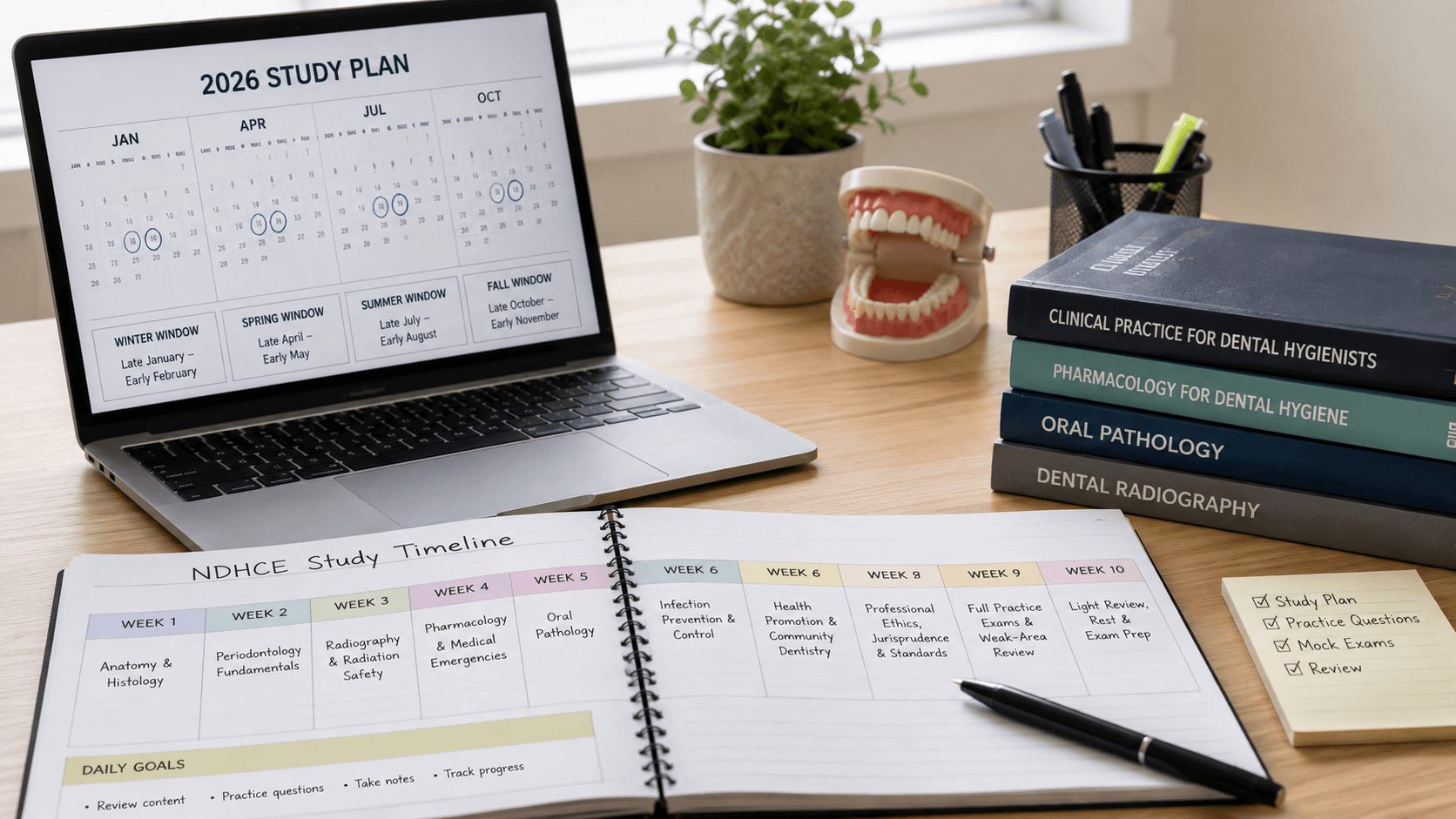
What a Sample 10-Week Study Plan Looks Like
Here is an example for a student targeting the late July 2026 window:
Week 1: Dental anatomy and histology review
Week 2: Periodontology fundamentals
Week 3: Radiography and radiation safety
Week 4: Pharmacology and medical emergencies
Week 5: Oral pathology
Week 6: Infection prevention and control (Canadian standards)
Week 7: Health promotion and community dentistry
Week 8: Professional ethics, jurisprudence, and practice standards
Week 9: Full practice exams and weak-area review
Week 10: Light review, rest, and exam-day prep
Adjust this based on your weak spots. If periodontology always trips you up, give it two weeks. If anatomy is solid, spend less time there.
5 Common Mistakes When Planning Your NDHCE Prep
A few planning mistakes can make NDHCE prep harder than it needs to be:
- Starting too late: A few weeks rarely gives you enough time to review weak areas properly.
- Studying without a plan: Without a schedule, it’s easy to spend too much time on familiar topics and avoid harder ones.
- Using non-Canadian resources: Different terminology, tooth numbering, and infection control standards can create confusion.
- Skipping practice questions: Testing yourself shows where your knowledge breaks down before exam day.
- Cramming at the end: Use your final days for light review and rest, not trying to relearn the whole exam.
A simple plan, steady practice, and the right resources will take you further than last-minute studying.
Stay on Track and Build Confidence Before Exam Day
Having a plan is one thing. Following it is another.
Block study time in your calendar, track what you complete, and check in with yourself each week so you can adjust before you fall behind.
As the exam gets closer, add timed practice to build stamina and find the areas that still need work.
If you want Canadian-focused practice, the NDHCE Mastery Bundle includes 2,800+ prep questions, full subject coverage, and mock exams.
You can also start with the free NDHCE prep quiz to get a feel for the question format.
What to Know Before Choosing Your NDHCE Exam Date
When do NDHCE exam applications open for 2026?
Application periods typically open several weeks before each testing window. The FDHRC posts exact deadlines on their website. Check early because seats can fill, especially for popular testing locations.
Can I change my exam date after registering?
Policies vary by testing window. The FDHRC may allow changes or withdrawals before certain deadlines, but fees may apply. Review the terms when you register.
What happens if I miss the application deadline?
You will need to wait for the next testing window. Missing a deadline can push your exam back by three months or more, so set reminders well in advance.
Is 8 weeks enough time to study for the NDHCE?
For most students, 8 weeks of focused study can work if you can dedicate several hours daily. If you are working, finishing school, or have significant time constraints, aim for 10 to 12 weeks.
Turn Your Exam Date Into a Study Plan
Choose your 2026 NDHCE exam date based on when you can realistically be ready, then work backward and give each subject enough time.
If you need help mapping out your prep, use our guide to preparing for the NDHCE to build a study plan around your exam date.