
Table of Contents
- What Is a Dental Hygiene Board Exam Practice Test?
- Why Canadian Students Need a Canada-Specific Practice Test
- How to Use a Practice Test to Identify Your Weak Areas
- Step 1: Take the Practice Test Under Real Exam Conditions
- Step 2: Review Every Wrong Answer. Not Just Your Score
- Step 3: Build a Targeted Study Plan Around Your Gaps
- Use Your Practice Test Results to Choose the Right NDHCE Prep Path
- What to Do After Your Practice Test: Next Steps for NDHCE Prep
- Start With a Free NDHCE Practice Quiz to See Where You Stand
- FAQs
What Is a Dental Hygiene Board Exam Practice Test and Why It Matters for the NDHCE
Preparing for the NDHCE can feel overwhelming because there is so much content to review. Dental hygiene students are expected to understand clinical care, oral pathology, pharmacology, radiography, infection prevention and control, community health, ethics, jurisprudence, periodontology, preventive dentistry, medical emergencies, and more. That is why a dental hygiene board exam practice test can be one of the most useful tools in your NDHCE preparation.
A practice test is not just a set of random questions. When used properly, it helps you understand how ready you are, where your weak areas are, and what you should study next. Instead of guessing what to review, a practice test gives you a clearer picture of your current knowledge and clinical reasoning.
For Canadian dental hygiene students, the right practice test can also help reduce surprises on exam day. The NDHCE is a Canadian board exam, so your preparation should reflect Canadian expectations, Canadian terminology, and Canadian clinical standards.
What Is a Dental Hygiene Board Exam Practice Test?
A dental hygiene board exam practice test is a simulated exam designed to help students prepare for the type of questions they may encounter on their certification exam.
In the NDHCE context, a good practice test should help you practise more than memorization. It should challenge you to apply your knowledge to realistic dental hygiene situations. That may include case-based questions, client scenarios, clinical decision-making, health history considerations, infection control decisions, medical emergency recognition, pharmacology interactions, and ethical or professional judgment questions.
The goal is not just to ask, “Do you know this fact?”
The better question is, “Can you use your knowledge like a safe, entry-level dental hygienist?”
That is the mindset students should bring into NDHCE preparation. The exam is not only testing whether you studied. It is testing whether you can think through realistic situations and make safe, appropriate decisions.
A practice test helps you build that skill before exam day.
Why Canadian Students Need a Canada-Specific Practice Test
One of the biggest mistakes Canadian dental hygiene students can make is relying too heavily on U.S.-based board exam resources.
At first, American dental hygiene practice questions may seem helpful. Many dental hygiene concepts overlap across Canada and the United States. Anatomy is anatomy. Periodontal concepts still matter. Radiographic interpretation is still important.
But the problem is that the NDHCE is not an American board exam.
Canadian students need to be careful because U.S.-based resources may use different terminology, different guidelines, and different exam expectations. That can lead to confusion, wasted time, and incorrect study habits.
For example, Canadian students need to be comfortable with FDI tooth numbering, while many American resources use the Universal numbering system. If your practice questions train your brain to think in a different numbering system, you may lose time translating information instead of focusing on the question.
Pharmacology can also differ. Drug names, clinical emphasis, prescribing expectations, and the way medications are framed in dental hygiene practice may not always match Canadian board exam preparation needs.
Infection prevention and control is another major area where Canada-specific preparation matters. Canadian IPAC expectations, terminology, and professional standards may differ from what you see in U.S. materials.
This does not mean U.S. resources are useless. But if your main preparation is based on the wrong country’s exam, you may spend valuable time studying details that are less relevant while missing the Canadian-specific expectations that matter most.
That is why a Canada-specific NDHCE practice test is so important. It helps you practise in the same “language” and clinical mindset you need for the Canadian dental hygiene board exam.
How to Use a Practice Test to Identify Your Weak Areas
A practice test should not be treated like a final judgment of your ability. It is better to think of it as a diagnostic tool.
Your score matters, but it is not the only thing that matters.
The real value of a practice test is what it tells you after you finish. It can help you see which subjects need more work, which question types slow you down, and which concepts you may have misunderstood.
A strong NDHCE prep strategy uses practice tests in three steps:
- Take the test under realistic exam conditions.
- Review every wrong answer carefully.
- Build a targeted study plan based on your weak areas.
This turns your practice test from a simple score into a study blueprint.
Step 1: Take the Practice Test Under Real Exam Conditions
To get an accurate baseline, you need to take your practice test seriously.
That means setting up your environment as close to exam conditions as possible. Choose a quiet space. Put your phone away. Do not use your notes. Do not pause the test every few questions to look something up. Set a timer if the practice test is timed.
This can feel uncomfortable, especially if you are not fully confident yet. But that is the point. You want to know where you actually stand before the real NDHCE.
If you take a practice test with notes open, distractions around you, or unlimited time, your result may not reflect your true readiness. You may feel better in the moment, but you will not get the same useful information.
A realistic practice test helps you practise your pacing, focus, and test-taking stamina. It also helps you experience what it feels like to make decisions when you are unsure, which is an important part of board exam preparation.
The goal is not perfection. The goal is honesty.
Step 2: Review Every Wrong Answer. Not Just Your Score
After finishing a practice test, many students immediately look at the final score and decide whether they feel good or bad.
But the score is only the beginning.
The most important part of a practice test is the review process. Every wrong answer is a clue. It tells you something about what you need to strengthen before exam day.
When reviewing your results, do not just ask, “What was the correct answer?”
Ask yourself:
Why did I choose the answer I chose?
Did I misunderstand the concept?
Did I miss a key word in the question?
Was I stuck between two options?
Was this a content problem or a test-taking problem?
Does this mistake fit a pattern?
For example, one wrong pharmacology question may not mean much. But if you miss several questions involving medications, contraindications, medical history, or adverse effects, that tells you pharmacology needs more focused review.
The same applies to IPAC, radiography, oral pathology, community health, periodontology, medical emergencies, ethics, and jurisprudence.
Patterns matter more than one individual mistake.
This is where practice tests become powerful. They help you move from “I need to study everything” to “I know exactly where I need to focus next.”
Step 3: Build a Targeted Study Plan Around Your Gaps
Once you know your weak areas, the next step is to turn that information into a study plan.
This is where many students get stuck. They take a practice test, feel discouraged by the results, and then go back to reviewing everything randomly.
A better approach is to prioritize your study time based on the gaps your practice test revealed.
Start by grouping your missed questions by subject. For example:
Pharmacology
Infection prevention and control
Oral pathology
Radiography
Periodontology
Community health
Medical emergencies
Ethics and jurisprudence
Dental materials
Preventive dentistry
Then rank those subjects by urgency. Which areas had the most missed questions? Which areas felt the most confusing? Which areas are high-impact for safe entry-level practice?
From there, build a weekly plan. Instead of saying, “I need to study pharmacology,” make it more specific.
For example:
“On Monday, I will review common medications and dental hygiene considerations.”
“On Tuesday, I will practise pharmacology case questions.”
“On Wednesday, I will review rationales and rewrite missed concepts in my own words.”
This makes your studying more focused and less overwhelming.
A practice test should help you stop guessing. It should show you what to study, why it matters, and how to use your time more effectively.
Use Your Practice Test Results to Choose the Right NDHCE Prep Path
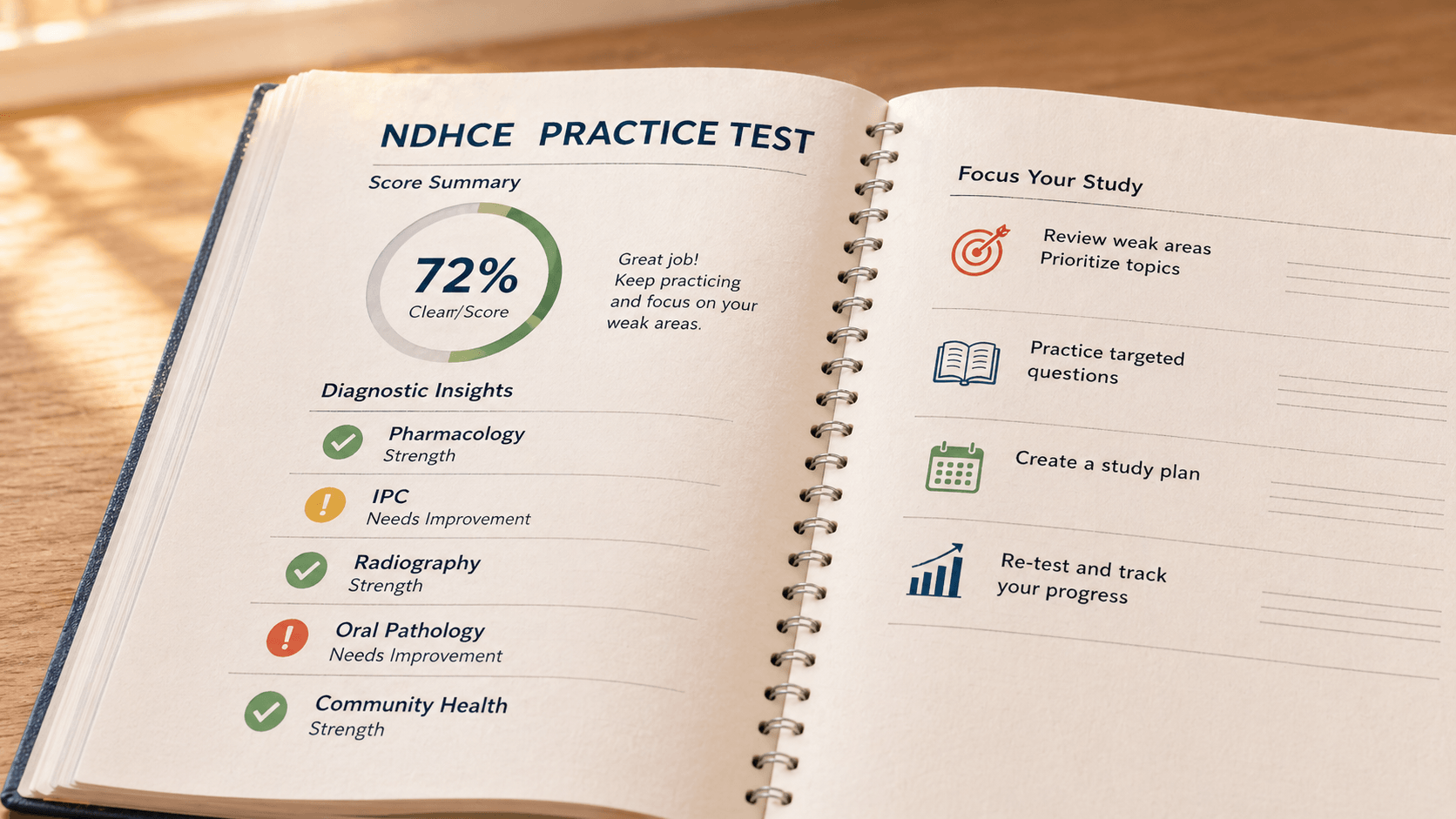
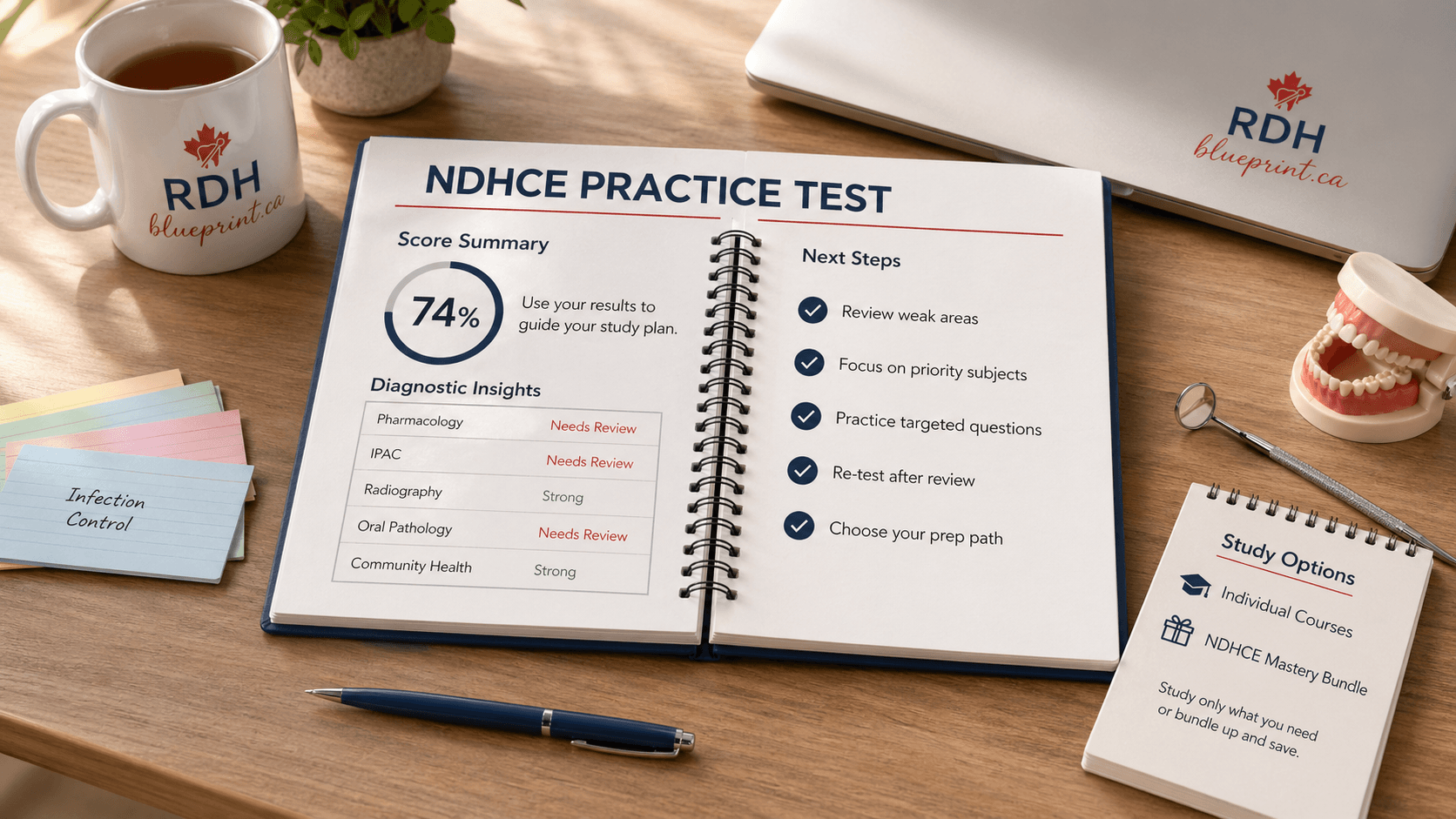
One of the most helpful parts of taking an NDHCE practice test is that it can show you where your biggest gaps are.
At RDH Blueprint, the practice test is designed to help you identify your areas of weakness so you can study more strategically. Instead of buying random resources or reviewing every subject equally, you can use your results to decide what kind of support you actually need.
For some students, that may mean choosing individual subject courses. For example, if your practice test shows that you are struggling with pharmacology, infection control, radiography, oral pathology, or community health, you may decide to focus on only those courses first.
This can be a helpful option if you already feel confident in some subjects and only need support in specific areas.
For other students, especially those who want full exam coverage and a more complete study plan, the NDHCE Mastery Bundle may be the better option. The bundle allows you to prepare across the major NDHCE subject areas while saving compared to purchasing courses one by one.
This way, your practice test becomes more than just a score. It becomes a guide for your next step.
You can review only the subjects you need most, or you can bundle up and save with the full NDHCE Mastery Bundle.
What to Do After Your Practice Test: Next Steps for NDHCE Prep
After you complete and review a practice test, your next step is to move into structured preparation.
That may include reviewing subject-specific modules, completing practice questions, studying rationales, and retesting yourself after you have worked on your weak areas.
The key is to avoid passive studying only. Reading notes can be helpful, but the NDHCE requires application. You need to practise using your knowledge in realistic scenarios.
A strong prep strategy may include subject-based review modules, case-style practice questions, full-length or timed simulations, rationale review, weak-area tracking, regular self-testing, and a final review plan before exam day.
This helps you build confidence gradually. You are not just trying to memorize more information. You are learning how to think through questions like a safe, entry-level dental hygienist.
That is especially important for students who feel overwhelmed by the size of the NDHCE blueprint. A practice test can help break the process into smaller, more manageable steps.
Start With a Free NDHCE Practice Quiz to See Where You Stand
If you are not sure where to begin, starting with a free NDHCE practice quiz can be a helpful first step.
RDH Blueprint offers Canadian-focused NDHCE prep resources designed specifically for dental hygiene students preparing for the Canadian board exam. The free quiz helps you check your current knowledge, identify possible weak areas, and begin building a more targeted study plan.
From there, you can choose the prep path that fits you best.
If you only need help in a few subjects, you can focus on individual RDH Blueprint courses. If you want full coverage and the best overall value, you can bundle up and save with the NDHCE Mastery Bundle.
Instead of wasting time wondering what to study next, you can start with a clearer picture of where you stand and a plan for what to do next.
The NDHCE can feel intimidating, but preparation becomes much more manageable when you have structure. A practice test helps you move from uncertainty to action.
Your goal is not just to study harder.
Your goal is to study smarter with Canadian-focused practice that prepares you for the exam you are actually writing.

FAQs
What is a dental hygiene board exam practice test?
A dental hygiene board exam practice test is a set of exam-style questions designed to help students prepare for their certification exam. For Canadian students, an NDHCE practice test should help you practise clinical judgment, case-based thinking, and safe entry-level dental hygiene decision-making.
Is the NDHCE the same as the American dental hygiene board exam?
No. The NDHCE is the Canadian dental hygiene certification exam. While some dental hygiene concepts overlap between Canada and the United States, Canadian students should be careful with U.S.-based resources because they may use different tooth numbering, terminology, pharmacology emphasis, and infection control expectations.
Why should I use a Canada-specific NDHCE practice test?
A Canada-specific NDHCE practice test helps you prepare for the exam you are actually writing. It can help you practise with Canadian terminology, FDI tooth numbering, Canadian-focused pharmacology considerations, and IPAC expectations that are more relevant to the NDHCE.
How can a practice test help me study for the NDHCE?
A practice test can help you identify your weak areas. Instead of guessing what to study next, you can review your results, look for patterns in your incorrect answers, and build a targeted study plan around the subjects that need the most attention.
Should I take a practice test before I finish studying?
Yes. Taking a practice test early can help you get a baseline of where you currently stand. You do not need to know everything before taking one. The goal is to identify gaps so you can study more strategically.
How should I take an NDHCE practice test?
For the most accurate results, take it under realistic exam conditions. Choose a quiet space, avoid notes, remove distractions, and use a timer if the test is timed. This helps you practise focus, pacing, and decision-making before test day.
What should I do after taking a practice test?
Do not focus only on your score. Review every incorrect answer and ask why you got it wrong. Look for patterns by subject area, such as pharmacology, IPAC, radiography, oral pathology, community health, or ethics and jurisprudence. Then use those patterns to decide what to study next.
What if I score low on my first practice test?
A low score does not mean you cannot pass the NDHCE. It means you have useful information about where to focus. Your first practice test should be treated as a diagnostic tool, not a final judgment of your ability.
Can I use my practice test results to choose RDH Blueprint courses?
Yes. RDH Blueprint’s practice test can help you identify your areas of weakness so you can choose the prep path that fits you best. You may decide to purchase only the individual subject courses you need, or you may choose the NDHCE Mastery Bundle for full coverage and better overall value.
What is the best way to prepare after a practice test?
The best next step is to create a targeted study plan. Focus first on your weakest and highest-impact subjects, review the related content, practise more questions, and then retest yourself to measure improvement. For many students, combining practice tests with structured modules and rationale review is the most effective approach.