
Table of Contents
- What Is the NDHCE Pass Rate in Canada?
- Does a High Pass Rate Mean the NDHCE Is Easy?
- Why the NDHCE Pass Rate Matters
- Why Some Candidates Struggle With the NDHCE
- How to Improve Your Chances of Passing the NDHCE
- Start With a Canada-Specific NDHCE Prep Plan
- Final Thoughts: The Pass Rate Is a Benchmark, Not Your Destiny
- FAQs
NDHCE Pass Rate in Canada: What Dental Hygiene Students Should Know
Preparing for the National Dental Hygiene Certification Examination, or NDHCE, can feel overwhelming. One of the first questions many Canadian dental hygiene students ask is: What is the NDHCE pass rate in Canada?
It is a fair question. The NDHCE is an important step toward becoming a registered dental hygienist in Canada, and the result can affect your registration timeline, finances, confidence, and career plans.
The good news is that most candidates pass the NDHCE. But the pass rate does not mean the exam should be taken lightly. The NDHCE still requires strong preparation, clinical judgment, and the ability to apply dental hygiene knowledge in realistic situations.
What Is the NDHCE Pass Rate in Canada?
The dental hygiene board exam in Canada is commonly known as the NDHCE.
According to FDHRC’s 2026 NDHCE overview, recent total NDHCE pass rates were:
| Year | Total NDHCE Pass Rate |
|---|---|
| 2021 | 86% |
| 2022 | 84.9% |
| 2023 | 85.5% |
| 2024 | 86.6% |
| 2025 | 87.1% |
These numbers show that most candidates pass. However, they also show that a meaningful number of candidates do not pass each year. A pass rate around 85–87% means that roughly 13–15% of candidates may be unsuccessful, depending on the year.
So the pass rate should be seen as context — not a guarantee.
Does a High Pass Rate Mean the NDHCE Is Easy?
No. A high pass rate does not mean the NDHCE is easy.
It means many candidates are prepared enough to meet the entry-to-practice standard. The exam still requires broad knowledge, decision-making, and application.
The NDHCE includes 200 questions total. Of those, 170 are operational questions that count toward your score, and 30 are experimental questions that do not count. Candidates do not know which questions are experimental.
The exam is divided into two sections of 100 questions. Candidates have two hours for each section, with a short break between sections.
FDHRC’s 2026 overview also explains that the exam includes knowledge, application, and critical thinking questions. Application questions make up the largest portion of the exam.
That matters because the NDHCE is not just asking, “Do you remember this fact?”
It may ask:
- What is the safest next step?
- What should the dental hygienist prioritize?
- Which intervention is most appropriate?
- What client factor changes the decision?
- Which answer best reflects entry-level dental hygiene practice?
This is why memorizing notes alone is usually not enough.
Why the NDHCE Pass Rate Matters
The NDHCE pass rate matters because the exam has real consequences.
For many candidates, passing the NDHCE affects when they can move forward with provincial registration, employment, and professional practice. Not passing may mean waiting for another exam sitting, paying another exam fee, and rebuilding confidence after a disappointing result.
As of the 2026 FDHRC fee schedule, the NDHCE registration fee is $850 plus applicable tax, including a non-refundable portion. Because of the cost and the career timeline involved, it makes sense to prepare seriously the first time.
The pass rate should not scare you. It should help you ask a better question:
What can I do to put myself in the strongest position before exam day?
Why Some Candidates Struggle With the NDHCE
Every student has a different background, program experience, and study timeline. Still, there are a few common reasons candidates may struggle.
Wasting Time on Resources Built for a Different Exam
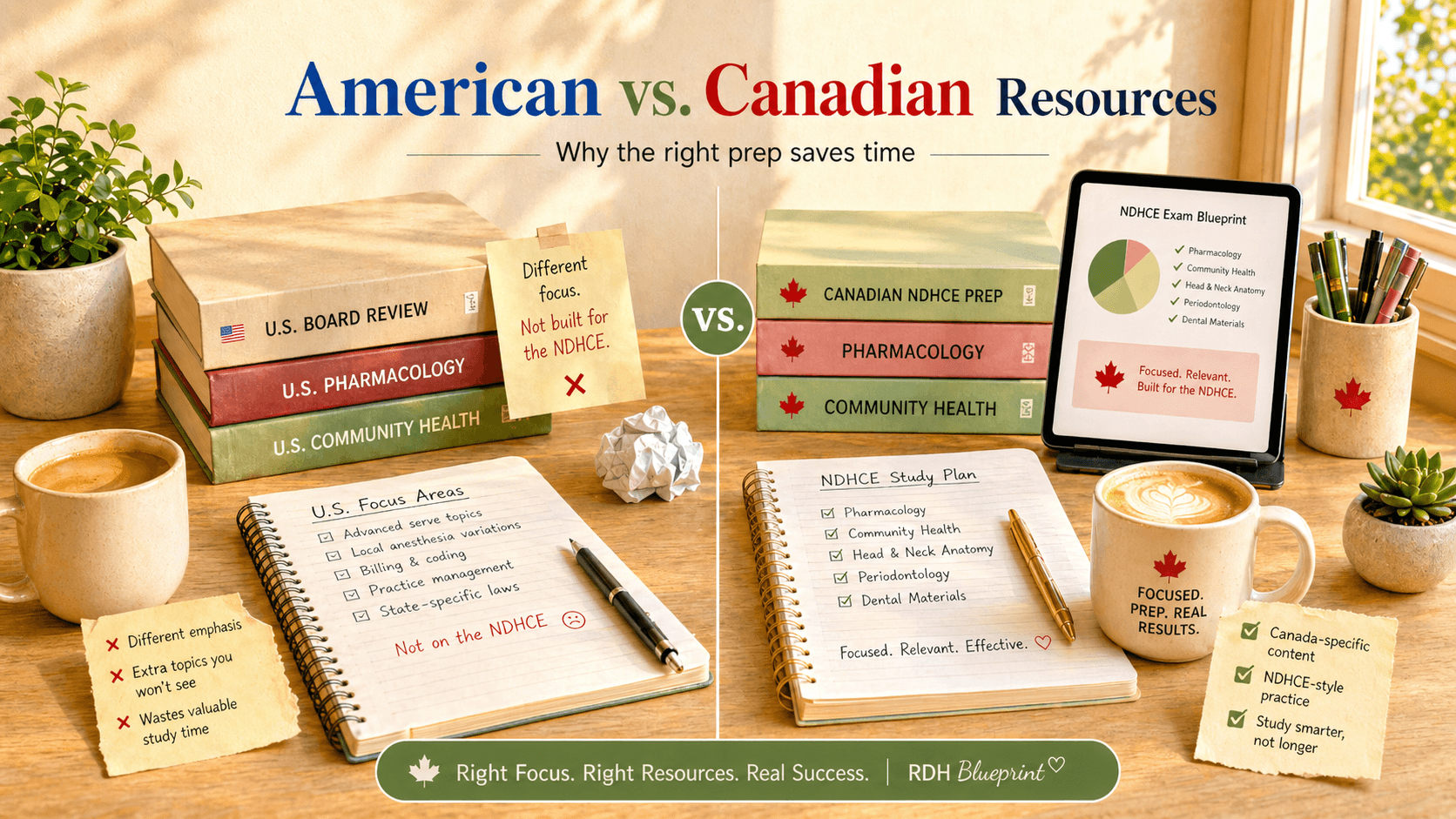
One of the biggest risks for Canadian dental hygiene students is not just studying the wrong information. It is spending valuable study time on resources that were built for a different exam.
Many U.S.-based dental hygiene resources can still teach useful general concepts. Topics like periodontal disease, oral pathology, instrumentation, and radiographic interpretation often overlap. The problem is that the NDHCE is a Canadian exam, and not every resource reflects what Canadian candidates are most likely to be tested on.
When your exam date is getting closer, time matters. Every hour spent reviewing low-yield or mismatched material is an hour you could have spent strengthening topics that are more relevant to the Canadian board exam.
This can make a real difference, especially in subjects where Canadian expectations may differ more noticeably.
Pharmacology is one area where Canadian students need to be careful. U.S.-based resources may focus on medications, classifications, prescribing patterns, or board-style priorities that do not always match Canadian expectations.
For the NDHCE, pharmacology is not just about memorizing drug names. You need to understand how medications affect dental hygiene care, medical history review, contraindications, adverse effects, interactions, and safe clinical decision-making.
A Canadian candidate may waste time studying details that are less relevant while missing the kind of applied pharmacology judgment the NDHCE expects.
Community health is another area where Canadian-specific preparation matters.
The Canadian exam may emphasize concepts such as population health, prevention, health promotion, access to care, vulnerable populations, public health programs, cultural safety, and Canadian dental hygiene practice expectations.
U.S.-based materials may approach public health through a different healthcare system, different insurance structures, different public programs, and different terminology. Even when the general principles overlap, the examples and priorities may not match the Canadian context.
The issue is not that every American resource is “bad.” The issue is opportunity cost.
If you have six weeks before the NDHCE, your study time is limited. You need resources that help you focus on the Canadian exam, Canadian terminology, and NDHCE-style application questions.
That does not mean you can never look at outside resources. But your main study plan should be built around Canada-specific NDHCE preparation, not generic board exam review.
Memorizing Instead of Applying
Another common issue is relying too much on memorization.
You may recognize information when reading your notes, but the exam may ask you to apply that knowledge to a client scenario. A question may include medical history, medications, periodontal findings, oral hygiene habits, and a client concern all at once.
To answer well, you need to connect the information and choose the best response.
Not Practising Enough NDHCE-Style Questions
Practice questions are important, but the style matters.
Simple recall questions can help with basic review, but NDHCE preparation should also include case-based and application-style questions. Good practice questions should include realistic distractors and clear rationales.
Rationales help you understand why one answer is best and why the other options are less appropriate. This is where a lot of learning happens.
Ignoring Weak Areas
Many students keep reviewing the subjects they already feel comfortable with. That feels productive, but it may not be the best use of study time.
Common weak areas include:
- pharmacology
- periodontics
- oral pathology
- radiography
- local anesthesia
- medical emergencies
- infection control
- community health
- ethics and jurisprudence
- research and statistics
A strong study plan should help you identify and review your weaker subjects before exam day.
How to Improve Your Chances of Passing the NDHCE
The national pass rate gives context, but your study strategy matters more.
Start With the Official NDHCE Blueprint
The official NDHCE blueprint helps you understand what the exam is designed to test. It can also help you avoid studying randomly or spending too much time on topics that are not as heavily emphasized.
Use the blueprint as your starting point, then build your study plan around the major domains and your personal weak areas.
Use Canadian Specific Study Resources First
Because the NDHCE is a Canadian exam, your main study resources should be Canada-specific.
This does not mean every non-Canadian resource is useless. It means Canadian resources should be your foundation. If you use American resources, use them carefully and only to support general concepts — not as your main roadmap.
This is especially important for topics like pharmacology, community health, ethics and jurisprudence, infection prevention and control, and professional practice.
A stronger study plan asks:
- Is this resource built for the NDHCE?
- Does it reflect Canadian dental hygiene expectations?
- Does it help me apply knowledge to client scenarios?
- Does it explain rationales clearly?
- Is this helping me study efficiently, or just giving me more content?
The goal is not to study everything. The goal is to study the right things well.
Practise With Rationales
Do not just check whether you got a question right or wrong.
Ask yourself:
- What was the question really asking?
- What clue did I miss?
- Why is the correct answer best?
- Why are the other options weaker?
- What topic do I need to review?
This turns every question into a learning opportunity.
Simulate Exam Conditions
The NDHCE is a long exam, so stamina matters. Practising under timed conditions helps you build confidence, manage fatigue, and learn how to move through questions without spending too long on one item.
Start With a Canada-Specific NDHCE Prep Plan
If you feel overwhelmed, the solution is not just to study harder. It is to study with more structure.
RDH Blueprint was created specifically for Canadian dental hygiene students preparing for the NDHCE. The goal is to help students focus on Canadian exam expectations, NDHCE-style thinking, and the subjects that matter most.
With RDH Blueprint, you can use Canada-specific review materials, subject-focused courses, practice questions, study guidance, and exam simulations to build confidence before exam day.
Preparing for the NDHCE? Start here.
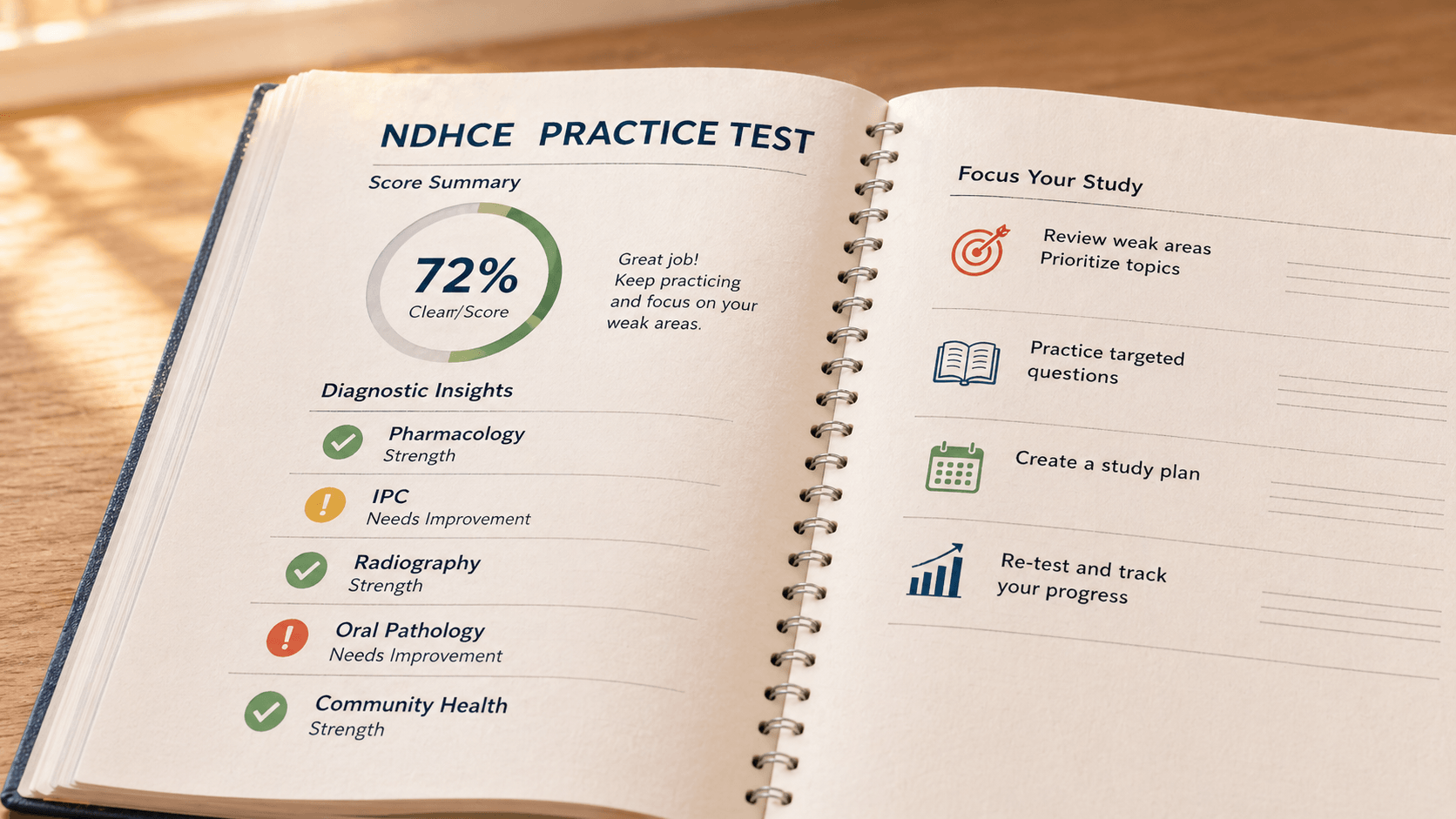
Take the free NDHCE prep quiz to see where you stand, identify weak areas, and get a clearer plan for what to study next.
Final Thoughts: The Pass Rate Is a Benchmark, Not Your Destiny
The NDHCE pass rate gives you helpful context, but it does not decide your outcome.
A national pass rate around 85–87% can be encouraging, but it should not lead to overconfidence. The exam still requires preparation, application, judgment, and Canada-specific understanding.
Focus on what you can control: your study plan, your weak areas, your practice questions, your rationales, your timing, and your confidence.
The pass rate is a benchmark. It is not your destiny.
With the right plan and consistent practice, you can walk into the NDHCE feeling more prepared, focused, and ready for the next step in your dental hygiene career.
FAQs
What is the NDHCE pass rate in Canada?
Recent FDHRC data shows total NDHCE pass rates around 85–87% in recent years.
Is the NDHCE hard to pass?
The NDHCE is passable, but it requires serious preparation. It tests knowledge, application, and critical thinking, not just memorization.
What percentage of candidates fail the NDHCE?
Based on recent pass rates, approximately 13–15% of candidates may be unsuccessful, depending on the year.
Does the NDHCE pass rate mean the exam is easy?
No. A high pass rate means many candidates are prepared enough to meet the standard. It does not mean the exam is easy.
Are U.S. dental hygiene board exam resources enough for the NDHCE?
U.S. resources may help with some general dental hygiene concepts, but they should not be your main study plan for the NDHCE. The Canadian exam may differ in emphasis, terminology, pharmacology expectations, community health context, ethics, jurisprudence, and professional practice. Using resources built for a different exam can waste valuable study time and leave gaps in the areas Canadian candidates need most.
How can I improve my chances of passing the NDHCE?
Use the official blueprint, follow a structured study plan, practise NDHCE style questions, review rationales carefully, track weak areas, and use Canada-specific study materials.