
Table of Contents
Tooth Numbering for the NDHCE: FDI vs. Palmer vs. Universal
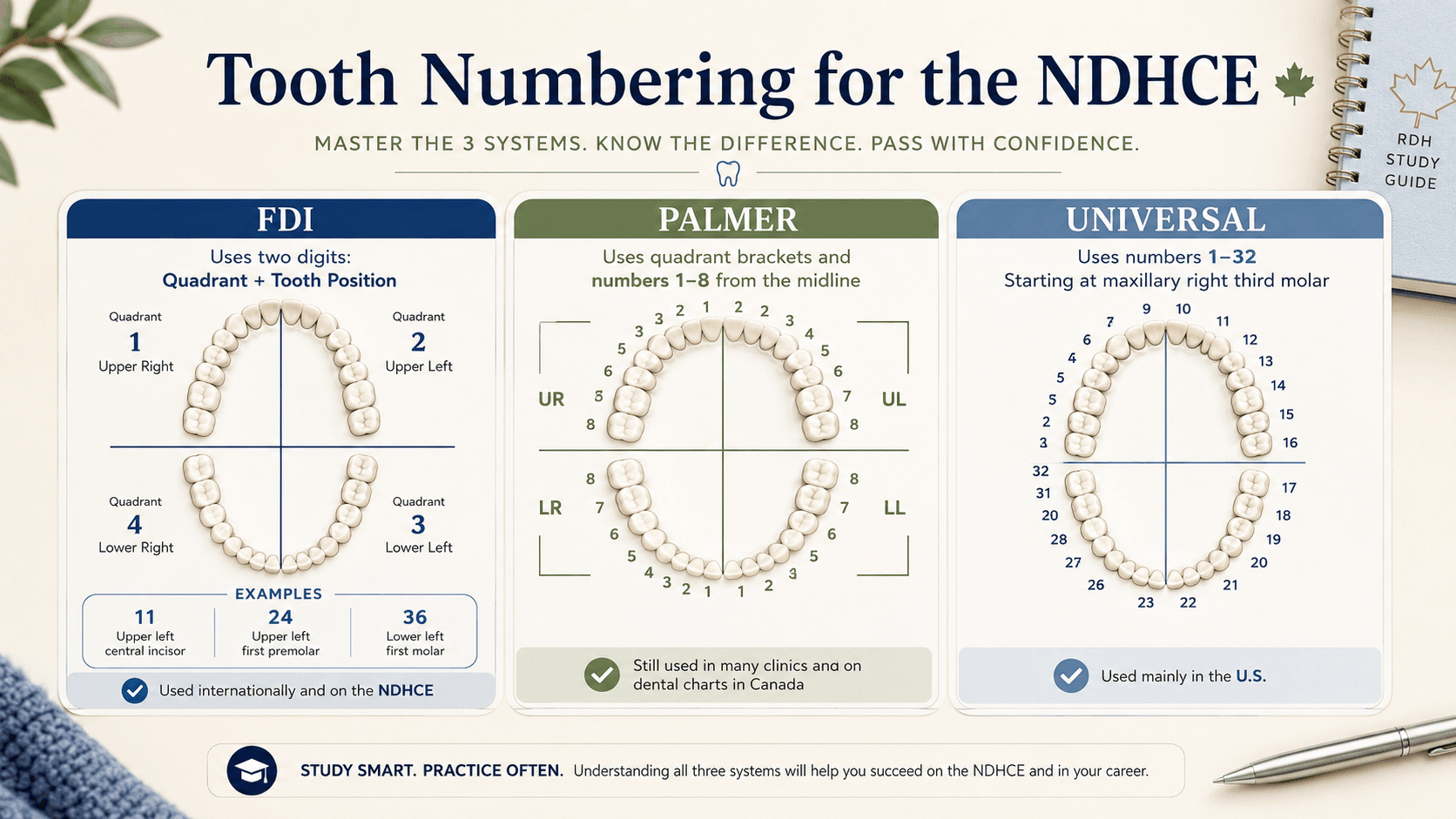
Tooth numbering for the NDHCE matters more than you might think. If you’re preparing for the Canadian dental hygiene board exam, you need to recognize the systems used in Canada, especially FDI and Palmer , without getting tripped up by U.S.-based Universal numbering.
What tooth numbering systems should Canadian students know?
For Canadian dental hygiene students, the most important system to know is FDI. You should also be familiar with Palmer notation, since it is still used in clinical settings such as charting and orthodontics.
The one to be cautious with is Universal numbering. It is widely used in the United States, but it is not the system Canadian students should rely on for NDHCE prep.
1) FDI Tooth Numbering
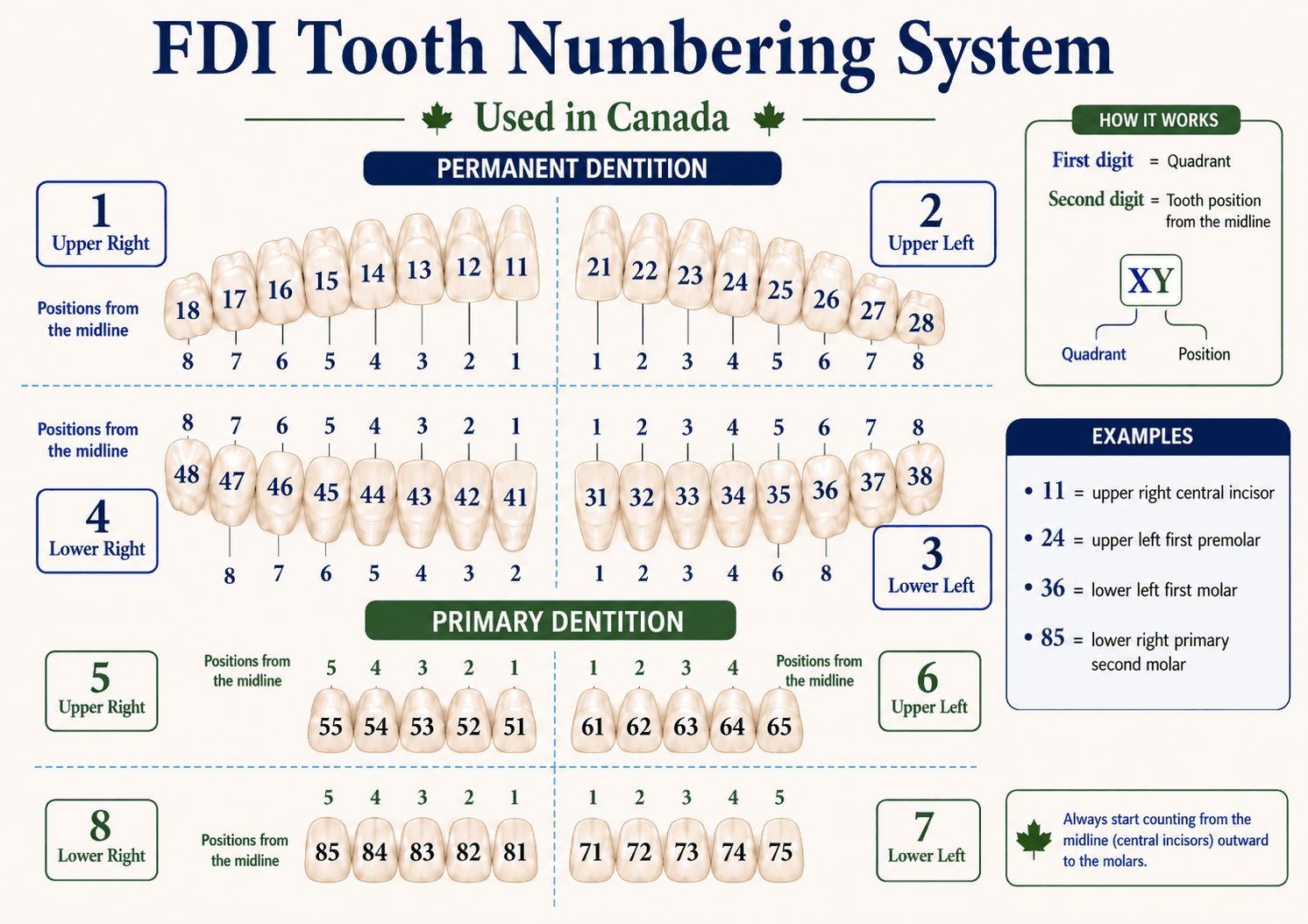
The FDI system uses two digits.
- The first digit tells you the quadrant
- The second digit tells you the tooth position from the midline
Permanent dentition quadrants:
- 1 = upper right
- 2 = upper left
- 3 = lower left
- 4 = lower right
Primary dentition quadrants:
- 5 = upper right
- 6 = upper left
- 7 = lower left
- 8 = lower right
So for example:
- 11 = upper right central incisor
- 16 = upper right first molar
- 24 = upper left first premolar
- 36 = lower left first molar
- 85 = lower right primary second molar
FDI is logical once you understand the pattern, which is why many Canadian students find it easier once they stop trying to “translate” from U.S. materials.
2) Palmer Notation
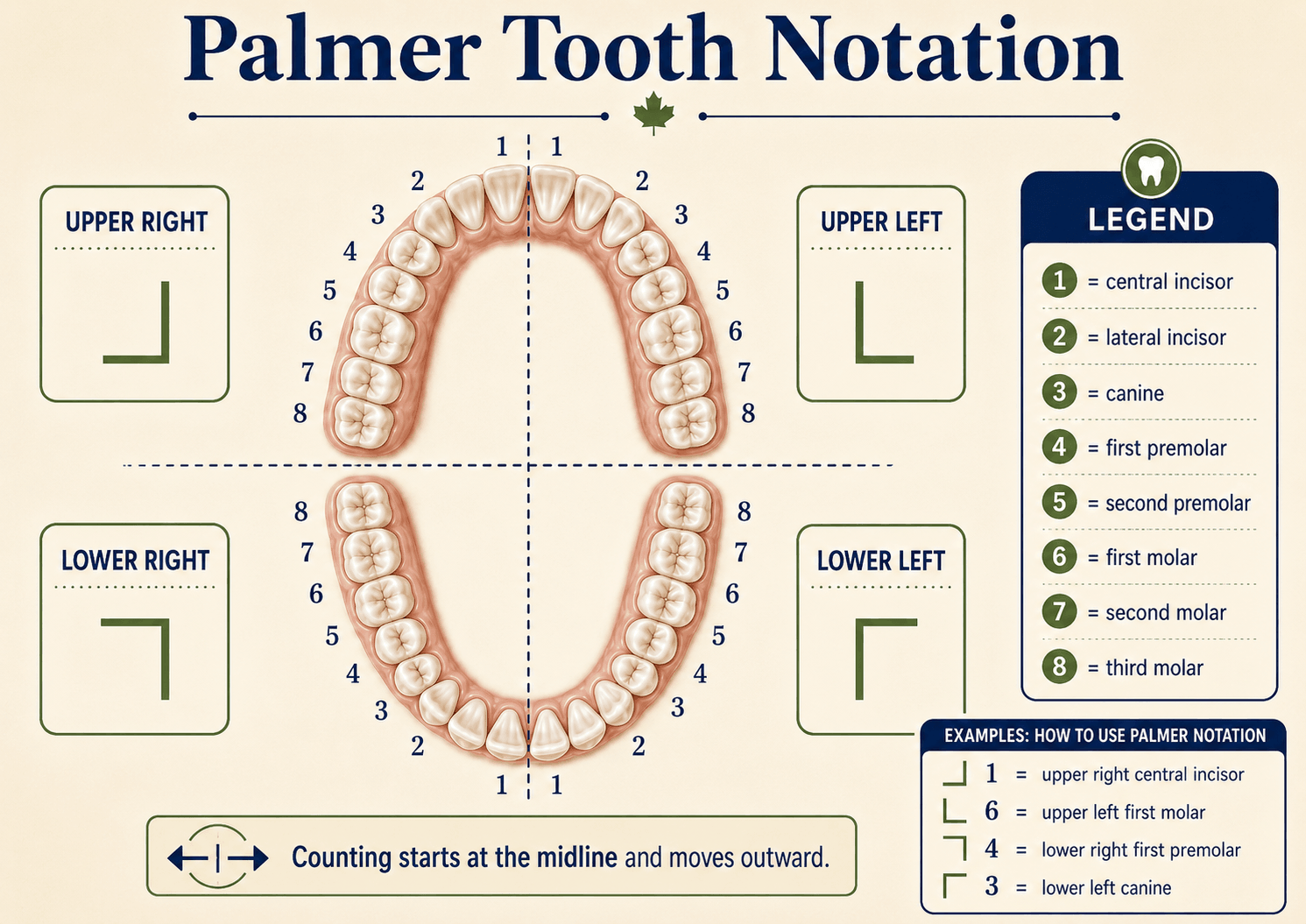
Palmer notation uses a number from 1 to 8 to show the tooth position from the midline, plus a quadrant symbol to show location.
For example:
- 1 = central incisor
- 2 = lateral incisor
- 3 = canine
- 4 = first premolar
- 5 = second premolar
- 6 = first molar
- 7 = second molar
- 8 = third molar
The number stays the same, and the quadrant bracket tells you whether the tooth is upper right, upper left, lower left, or lower right.
Palmer can feel awkward in plain text because the quadrant symbols are visual, but you should still know how it works. In Canadian practice, it may appear in charting, clinical notes, or orthodontic contexts.
Alt text: Palmer tooth numbering system with quadrant symbols and tooth positions.
3) Universal Numbering
The Universal system numbers permanent teeth from 1 to 32 and primary teeth from A to T.
For permanent teeth, numbering begins at the upper right third molar (#1), moves across to the upper left third molar (#16), then drops down to the lower left third molar (#17) and continues across to the lower right third molar (#32).
This is a valid system , but it is mainly associated with the United States.
Here’s where students get tripped up: a U.S. resource may refer to Tooth #19, while a Canadian student preparing in FDI should be thinking of 36. That mental translation wastes time and increases the chance of error.
Why this matters for the NDHCE
The NDHCE is not just testing whether you can memorize facts. It tests whether you can think clearly in a clinical context.
That means tooth numbering may show up in:
- charting questions
- radiographic interpretation
- restorative scenarios
- local anesthesia questions
- oral pathology cases
- periodontal case questions
If you are mentally converting between systems, you’re making the exam harder than it needs to be.
Common mistakes students make
Here are a few common slip-ups:
- mixing up right and left from the patient’s perspective
- reading FDI numbers like “thirty-six” instead of quadrant 3, tooth 6
- confusing permanent quadrants 1–4 with primary quadrants 5–8
- depending too much on U.S. study resources
- not recognizing Palmer notation when it appears in a clinical context
How to study tooth numbering more effectively
The more comfortable you are with tooth numbering for the NDHCE, the less likely you are to waste time translating systems during case-based questions.
Do yourself a favour: Stay in Canadian mode.
You’re already stressed enough studying for the NDHCE. The last thing you need is to waste brainpower translating U.S. tooth numbers into the systems you’re expected to recognize in Canada.
That’s exactly why I created RDH Blueprint to save you time, reduce frustration, and help protect you from silly, avoidable mistakes on the final board exam. RDH Blueprint helps Canadian students practise tooth numbering for the NDHCE using Canadian-focused study resources, practice questions, and exam-style review.
Instead of piecing together random resources and wondering, “Is this even Canadian?” you can study with materials built specifically for Canadian dental hygiene students.
Start with the free NDHCE prep quiz and study resources, or get the full RDH Blueprint Mastery Bundle if you want everything organized in one place. If you done studying, why not take a NDHCE prep exam that actually simulates what you will encounter on exam day?
And yes — if you grab the Mastery Bundle today, your future self might just thank you tomorrow.
Tiny bonus for detail-oriented readers: if you’ve made it this far, tuck away the code MAPLE20 for a little surprise at checkout.
Good luck, and stay CANADIAN =]
FAQs
What tooth numbering system should I know for the NDHCE?
Canadian students should be comfortable with FDI and able to recognize Palmer notation.
Should I study Universal numbering for the NDHCE?
Universal numbering is common in U.S. resources, but Canadian students should avoid making it their main study system.
Why does tooth numbering matter on the NDHCE?
Tooth numbers may appear in charting, radiography, periodontal, restorative, local anesthesia, and case-based questions.