
Table of Contents
Don’t Blink! My Honest (and Slightly Traumatic) NDHCE Experience.
The "Over-Prepared" Paradox
To say I was prepared for the board exam is an understatement. I started studying six months before school even started. Dental Hygiene was a second career for me, and after surviving a long stretch of unemployment due to eye problems, I knew this was a second chance I couldn't afford to blow.
I wasn't just a student; I was a studying machine. I studied every weekend, every holiday, and I’m fairly certain I was the most prepared person in the province. I had color-coded tabs for my color-coded tabs. I knew the Krebs cycle better than I knew my own family’s birthdays. I was ready to walk into that exam centre like a gladiator entering the Colosseum.
 My highlighters have highlighters
The Reality Check
Yet, sitting in that chair, I honestly felt very frustrated. You expect the board exam to be a fair fight, a test of your hard-earned knowledge. Instead, it felt like being asked to solve a riddle written by someone who had never actually seen a human mouth.
I expected questions like: "Name the primary bacterium in localized aggressive periodontitis."
Instead, I got: "If a patient walks in with a slight limp, a history of eating kale on Tuesdays, and a fear of the color mauve, which clock-position should you sit in?"
The NDHCE has a special way of making you feel like you’ve studied the wrong planet, let alone the wrong textbook. Here’s the "honest" truth about that day:
The "Most Right" Answer: Every question has four answers. Two are obviously wrong, and two are so identical they might as well be twins. Choosing between them felt like picking a favorite child.
The Brain Fog: After four hours of staring at a screen, I forgot how to spell "tooth." I started second-guessing things I’d known since semester one.
The Eye Rolls: I spent years worrying about my vision, only to realize that even with 20/20 sight, some of these case study radiographs look like tea leaf reading. Is that an abscess, or just a smudge on the monitor?
The "All-Seeing Eye" Protocol
As if the questions weren't enough, the proctoring rules felt like I was being processed into a high-security prison. "Don't look away from the screen." "Don't move your mouth—the algorithm will flag you."
I sat there, frozen, convinced that if I so much as blinked rhythmically, a SWAT team would burst through the door for "cheating via Morse code." I wanted to yell, "I’m not cheating! I’m just trying to remember if this patient has a heart murmur or needs a hug" but I couldn't move my lips. I had officially entered "Human Statuette" mode.
The Question 5 Meltdown
By the fifth question, the panic set in. I couldn't believe what I was reading. My internal monologue was a disaster:
“It’s over. I’m going to fail. Two years of my life, thousands of dollars in tuition, and a second career dream, all down the drain because of this."
I felt like a total failure. I was already planning my "I'm sorry" speech to my family.
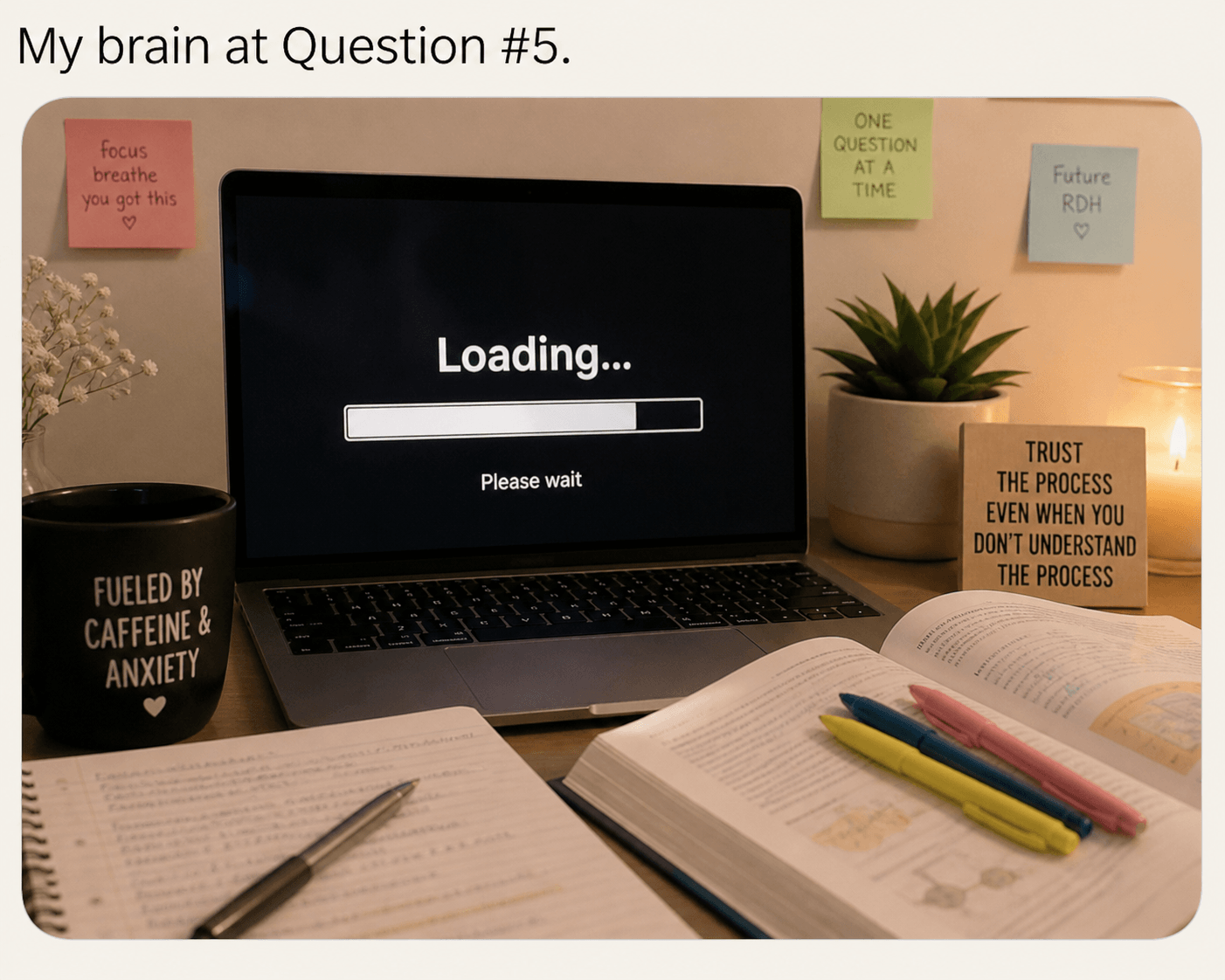 My Brain after 5 questions on the NDHCE
The Turnaround
But since I was trapped in that chair and forbidden from moving my face anyway, I figured I might as well finish the job. I kept going.
Then, around question 25, something weird happened. The "NDHCE Fog" started to lift. The questions started to feel less like traps and more like... actual dental hygiene? I realized I hadn't forgotten everything; I just had to get past the board’s "hazing" phase. Once I stopped trying to outsmart the algorithm and started trusting the thousands of hours I’d put in, the rhythm came back.
The Finish Line
Despite the early spiral, the finish line appeared sooner than I thought. When I clicked through the final slide, I realized I actually had extra time.
I was one of the first students finished, which gave me the chance to do the unthinkable: go back and review. Looking at those first 25 questions again with a slightly lower heart rate, I realized they weren’t actually written in a foreign language. They were just... questions. They weren't nearly as bad as my panic had made them out to be.
The Verdict
I hit "Submit," walked out of the room, and stepped into the fresh air. Even though I’d finished early and reviewed my work, that board exam trauma is real. I spent the drive home convinced I was the one person who had somehow hallucinated the right answers.
But as it turns out? I passed.
In fact, my entire cohort passed. All those weekends lost to textbooks, the "don't move your mouth" paranoia, and the kale-on-Tuesdays riddles finally paid off. We weren’t just students anymore; we were colleagues.
The Moral of the Story: The NDHCE is 50% what you know and 50% not letting your own brain convince you that you've forgotten it all. Sit still, keep clicking, and trust the work you put in.
 We All Passed the NDHCE
Ready to Start Preparing for the NDHCE?
If you’re getting ready for the NDHCE, don’t wait until Question 5 to realize you need a clear study plan.
RDH Blueprint was created to help Canadian dental hygiene students study the right material, practise realistic board-style questions, and build confidence before exam day.
Start with free NDHCE prep resources, then choose the courses or practice exams that match your weak areas.
FAQs
Is the NDHCE hard?
The NDHCE can feel hard because many questions are case based and ask you to choose the most appropriate answer, not just recall facts. Even well prepared students can feel unsure during the exam, especially in the first few questions.
Is it normal to panic during the NDHCE?
Yes. Many students feel anxious at the beginning of the exam, especially when the first few questions feel confusing. The key is to keep going, read carefully, eliminate obviously wrong answers, and trust the preparation you have already done.
What should I do if I get stuck on an NDHCE question?
Pause, reread the question, identify what the question is really asking, and eliminate the weakest options. If two answers seem close, choose the safest entry level dental hygiene response and move forward. Do not let one question ruin the rest of the exam.
How can I prepare for the NDHCE?
Use Canadian focused NDHCE prep, practise case based questions, review rationales, and focus on your weak areas. A good prep plan should help you build both knowledge and confidence before exam day.