
TL;DR:
Yes, the dental hygiene exam is hard, but it's designed to test clinical judgment, not trick you. With the right prep strategy focused on case-based thinking and Canadian-specific content, you can walk into the NDHCE feeling ready.

You've spent years in clinical rotations, passed your school exams, and handled real patients. So why does the thought of the NDHCE make your stomach drop?
The fear is real. You only get three attempts at this exam, and each one costs money you don't have to spare. You've heard stories of students who felt confident walking in and walked out stunned. You're wondering if you've studied the wrong things, or if there's some secret everyone else knows.
Here's what nobody tells you: the NDHCE isn't hard because the content is impossible. It's hard because it tests you differently from how school did. Understanding that difference is the first step toward feeling ready.
Why the NDHCE Feels Harder Than School Exams
School exams test whether you memorized the material. The NDHCE tests whether you can use it.
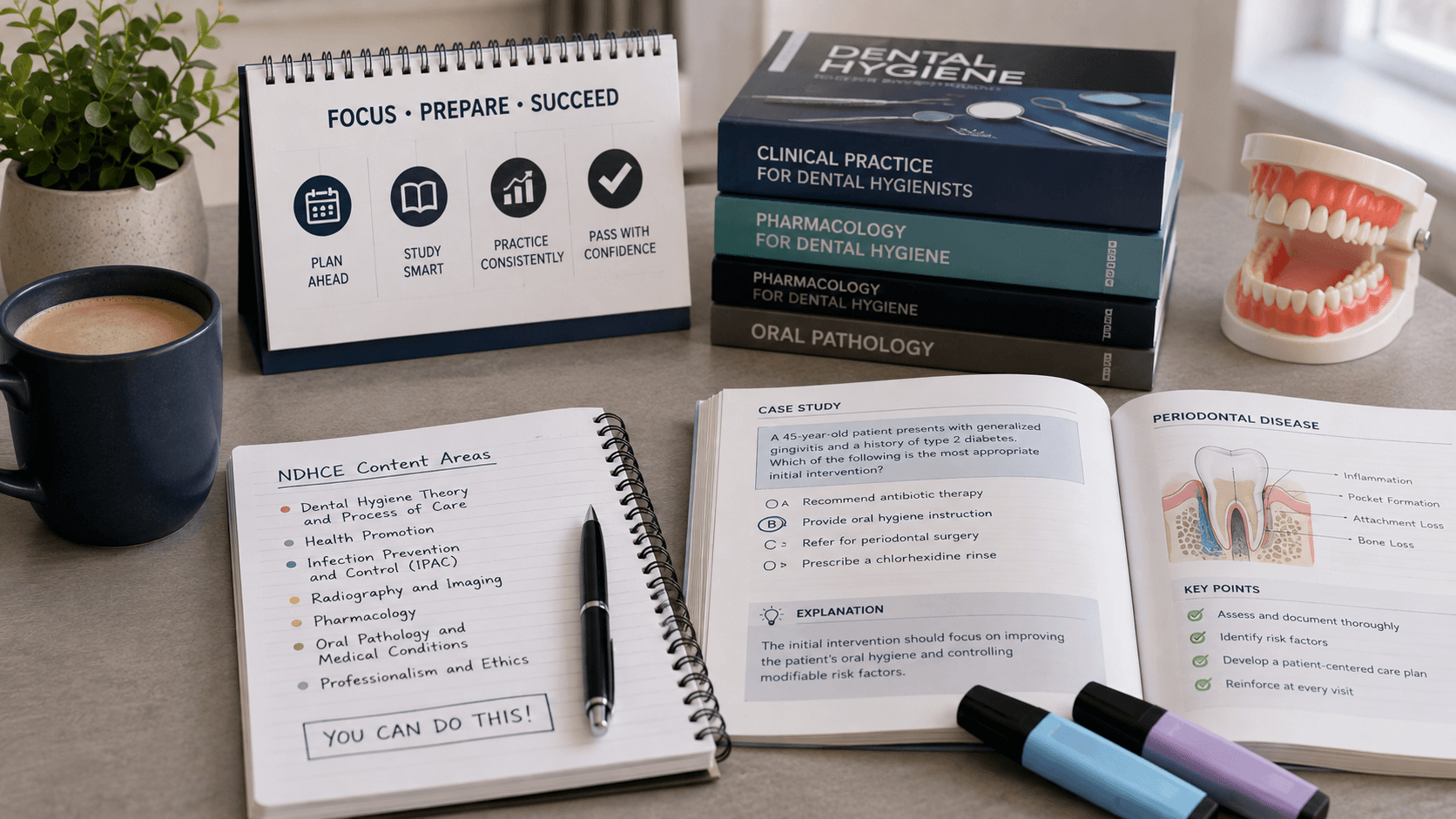
That's the core difference. In school, you might be asked to name the stages of periodontal disease. On the dental hygiene board exam, you'll get a patient scenario with bleeding on probing, specific probing depths, medical history details, and radiographic findings. Then you'll need to decide what treatment approach is appropriate for this patient.
The exam uses case-based questions that require you to:
- Analyze multiple pieces of patient data at once
- Rule out answers that might be technically correct but aren't best for this situation
- Apply clinical judgment under time pressure
This style of testing catches many students off guard. You can know all the facts and still struggle if you haven't practiced thinking through cases.
The Three-Attempt Limit Adds Real Pressure
You're allowed three attempts at the NDHCE. That's it. If you don't pass after three tries, you can't become a registered dental hygienist in Canada.
This isn't just a test. It's a career gate with a hard limit. That pressure affects how you study, how you sleep, and how you perform on exam day. Acknowledging this stress is important because pretending it doesn't exist won't help you manage it.
What Actually Makes the Exam Challenging
The NDHCE covers a lot of ground. You're responsible for:
- Periodontics and assessment
- Dental anatomy and tooth morphology
- Radiography and image interpretation
- Pharmacology (Canadian drug names and protocols)
- Medical emergencies
- Oral pathology
- Infection prevention and control (Canadian standards)
- Ethics and jurisprudence (provincial regulations)
- Health promotion and community dental health
That's a wide scope. But the volume of content isn't the hardest part.
The Real Difficulty: Clinical Reasoning Under Time Constraints
You have roughly one minute per question. For straightforward recall questions, that's plenty. For a complex case with a patient history, medications, clinical findings, and four plausible answer choices, one minute feels tight.
The exam rewards students who can quickly identify the most relevant details and eliminate distractions. This is a skill you build through practice, not just by reviewing notes.
Canadian-Specific Content Matters
If you've been using American prep materials, you've likely encountered:
- Drug names and dosages that differ from Canadian protocols
- The Palmer or Universal numbering systems, instead of FDI notation
- IPAC standards that don't match Canadian guidelines
- State-based regulations that don't apply here
Every time you have to translate US content to Canadian standards mentally, you're adding cognitive load. That slows you down and increases your chance of errors. Studying Canadian-focused content from the start eliminates this problem.
Is the NDHCE Pass Rate Actually Low?
The NDHCE doesn't publish detailed pass rate statistics publicly. What we know from available information and student reports suggests that most first-time test-takers who prepare adequately pass.
But "most" isn't "all," and the students who struggle often share common patterns:
- They relied heavily on memorization without practicing case application
- They used prep materials designed for US exams
- They didn't take enough timed practice tests to build exam stamina
- They underestimated how different the exam format would feel
The exam isn't designed to fail you. It's designed to confirm you can think like a clinician. If your prep focuses on that skill, you're in a much stronger position.
For more context on what the numbers actually look like, see our breakdown of the NDHCE pass rate in Canada.
How to Prepare for the Dental Hygiene Board Exam
Knowing the exam is hard doesn't help unless you know what to do about it. Here's a practical approach.
Focus on Case-Based Practice
Get comfortable with patient scenarios. Every study session should include questions that ask you to interpret clinical data and choose the best course of action. Pure memorization isn't enough.
Look for prep materials that mirror the exam format: patient cases with multiple variables, time limits, and answers that require judgment calls.
Use Canadian-Specific Materials
Don't waste time translating American content. Study with resources that use FDI numbering, Canadian pharmacology, and IPAC standards that match what you'll see on the exam and in practice.
Identify Your Weak Areas Early
Take a diagnostic test before you start your main study phase. Find out where you're strong and where you need work. Then allocate your time accordingly.
Most students have one or two subjects that feel shakier than the rest. It could be medical emergencies. It could be radiography interpretation. Target those areas with extra practice questions and review.
Build Exam Stamina
The NDHCE is a long test. You need mental endurance to stay focused through the final questions. Take full-length practice exams under realistic conditions: timed, no breaks where breaks aren't allowed, no looking things up.
This builds the stamina and pacing instincts you'll need on exam day.
Manage Your Stress
Easier said than done, but chronic stress impairs memory and decision-making. Build breaks into your study schedule. Get enough sleep. Practice questions until you feel genuine confidence, not just hope.
Confidence comes from preparation that mirrors the real test. When you've worked through hundreds of case-based questions successfully, you'll have evidence that you can do this.
For a more detailed prep plan, check out our guide to passing the NDHCE on your first try.
What Other Students Say About the NDHCE
Student forums and discussion threads reveal consistent themes. Many candidates say the exam felt harder than expected, especially the case-based questions. Others say they felt prepared because they practiced with realistic materials.
The difference usually comes down to prep quality, not raw intelligence or how well someone did in school. If you're curious about real student experiences, we compiled insights in our article on what NDHCE candidates are really saying.
If you're looking for Canadian-focused prep materials that emphasize case-based questions and clinical judgment, explore how RDH Blueprint approaches NDHCE preparation. Everything is built for Canadian students, so you never have to translate US content or wonder if you're studying the right standards.
What to Know Before You Write the NDHCE
How long should I study for the NDHCE?
Most students need eight to twelve weeks of focused preparation, depending on how recently they finished school and how confident they feel with the material. If you're working or have other obligations, give yourself more time and study in shorter, consistent sessions rather than cramming.
Can I pass the NDHCE without a prep course?
Yes, some students pass using only their school notes and free resources. But the students who feel most confident typically use structured prep materials with realistic practice questions. A good prep course helps you identify gaps and practice the case-based thinking the exam requires.
What happens if I fail the NDHCE?
You can retake the exam, but you get only three attempts in total. If you don't pass after three tries, you cannot become registered as a dental hygienist in Canada. If you fail once, use the experience to identify where you struggled and adjust your prep before the next attempt.
Is the NDHCE harder than dental hygiene school?
The content isn't necessarily harder, but the format is different. School tests often reward memorization. The NDHCE rewards clinical reasoning and the ability to apply knowledge to patient cases. Students who only memorize without practicing application often find the exam harder than expected.
Prepare for How the NDHCE Actually Tests You
The NDHCE is challenging because it asks you to apply what you know rather than simply recall facts. Focus on case-based questions, Canadian-specific content, and timed practice.
For a more structured approach, use our NDHCE prep guide to plan your review.